Learn how BrandRank.ai normalization transformation rules improve AI visibility, SEO, and data quality. Discover examples, best practices, and implementation tips.
Intro
Modern AI search engines don’t just read content—they interpret entities, relationships, and structured information. As tools like ChatGPT, Gemini, and other AI-powered search experiences become a major source of online discovery, brands need consistent and well-structured data to improve how they are understood. This is where BrandRank.ai normalization transformation rules come into the picture.
These rules help organize inconsistent brand information into a standardized format that AI systems can process more accurately. Whether it’s company names, product titles, categories, metadata, or structured content, normalization reduces ambiguity and improves consistency across digital channels.
In this guide, you’ll learn what BrandRank.ai normalization transformation rules are, why they matter for SEO and AI visibility, how they work, and how businesses can apply similar principles to improve data quality and brand discoverability.
Also read
https://aiustadhub.com/wp-admin/post.php?post=174&action=edit
What Are BrandRank.ai Normalization Transformation Rules?
BrandRank.ai normalization transformation rules are a set of data-processing principles designed to convert inconsistent or unstructured information into a standardized format. The goal is to ensure that brand-related data is accurate, consistent, and easier for AI systems and search technologies to interpret.
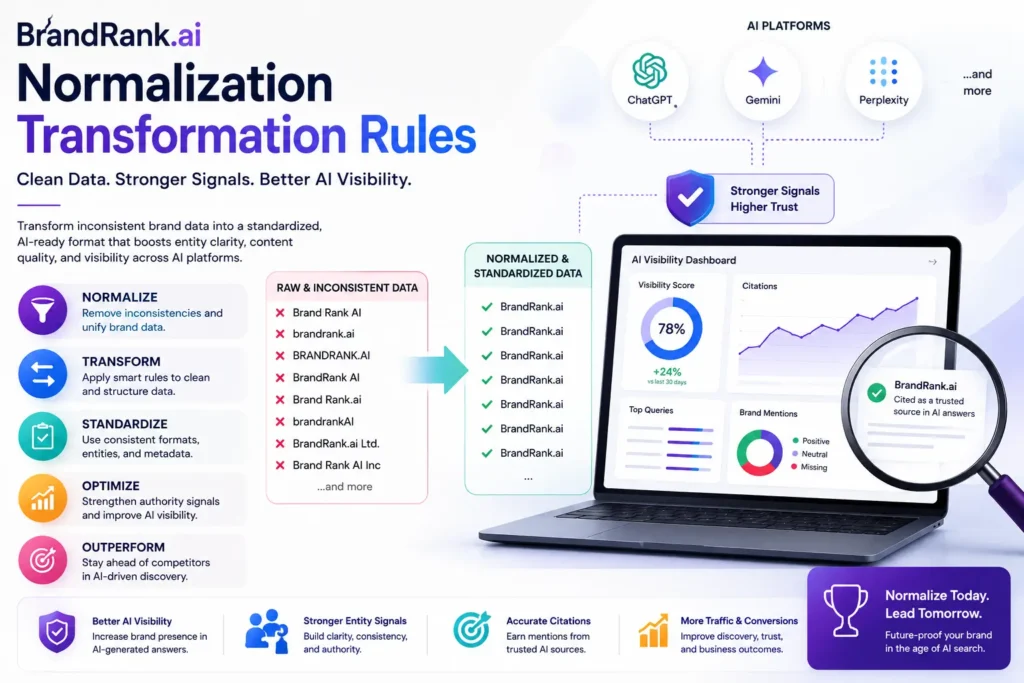
Think of normalization as creating a single “official version” of every important piece of information.
For example, a company may appear online as:
- ABC Solutions
- ABC Solutions Ltd.
- ABC Solutions Limited
- ABC Solutions Inc.
Although these names refer to the same business, an AI model may initially treat them as separate entities if the surrounding context is inconsistent. Normalization maps these variations to one standardized name, making it easier for AI systems to recognize that they represent the same organization.
The same principle applies to:
- Brand names
- Product names
- Categories
- Job titles
- Vendor names
- Addresses
- Metadata
- Structured content
By applying transformation rules consistently, businesses create cleaner datasets that support stronger analytics, improved search visibility, and better AI understanding.
Why Are They Called “Transformation Rules”?
Normalization is only one part of the process. Before data becomes standardized, it usually needs to be transformed.
Transformation rules define exactly how raw information should be cleaned and converted. Depending on the dataset, they may include:
- Converting text into a consistent format
- Removing duplicate records
- Correcting spelling inconsistencies
- Standardizing abbreviations
- Mapping multiple values to one official value
- Removing unnecessary characters
- Organizing data into a consistent structure
Instead of manually correcting thousands of records, transformation rules automate these tasks using predefined logic.
Why Brand Normalization Matters in the AI Search Era
Traditional search engines primarily ranked webpages. Today’s AI-powered search experiences go much further by identifying entities, summarizing information, and generating direct answers.
Because of this shift, inconsistent brand data can reduce how confidently AI systems understand and reference a business.
Consider these examples:
- A product appears under three different names across multiple websites.
- The company’s legal name differs from its marketing name.
- Job titles are written differently in every department.
- Categories change between the website, CRM, and product database.
Although people can usually understand these differences, AI systems depend on consistent signals. When those signals conflict, confidence decreases.
Normalization helps solve this challenge by ensuring the same concepts are represented consistently across all digital assets.
Benefits of BrandRank.ai Normalization Transformation Rules
Applying structured normalization principles offers several practical advantages:
- Improves data consistency across websites and databases.
- Reduces duplicate or conflicting information.
- Helps AI systems identify entities more accurately.
- Creates cleaner datasets for reporting and analytics.
- Simplifies large-scale SEO and content management.
- Supports structured data initiatives.
- Improves collaboration between marketing, sales, and data teams.
Rather than focusing only on search rankings, normalization strengthens the overall quality of your digital information, making it more reliable for both humans and AI systems.
A Simple Example
Imagine an online store that sells the same product under multiple names:
- Wireless Earbuds Pro
- Pro Wireless Earbuds
- Wireless Earbuds Professional
- Earbuds Pro
Without normalization, reporting tools may treat these as separate products.
After applying transformation rules, all variations can be standardized to a single approved product name. As a result, performance reports become more accurate, duplicate listings are reduced, and AI systems receive clearer signals about the product.
This simple example illustrates why normalization is increasingly important as organizations manage larger volumes of content and structured data.
Understanding Data Normalization
To fully understand BrandRank.ai normalization transformation rules, it’s important to first understand the broader concept of data normalization.
Data normalization is the process of organizing, cleaning, and standardizing data so that it follows consistent rules. The objective is to eliminate duplicate information, reduce inconsistencies, and create a reliable dataset that can be accurately interpreted by databases, analytics platforms, search engines, and AI models.
For example, consider a customer database that contains the following company names:
| Original Data | Normalized Data |
|---|---|
| Microsoft Corp | Microsoft |
| Microsoft Corporation | Microsoft |
| Microsoft Inc. | Microsoft |
| MSFT | Microsoft (where appropriate) |
Without normalization, software may treat each variation as a separate company. After normalization, all records point to a single standardized entity, making reporting and analysis far more accurate.
Normalization is widely used across many industries, including:
- Search engine optimization (SEO)
- Customer relationship management (CRM)
- Business intelligence
- Machine learning
- Financial reporting
- Healthcare records
- E-commerce product catalogs
- Marketing automation
Although the implementation differs by industry, the goal remains the same: transform inconsistent data into a consistent, trustworthy format.
How BrandRank.ai Normalization Transformation Rules Work
BrandRank.ai normalization transformation rules follow a structured workflow that converts raw information into standardized, AI-friendly data. Instead of manually correcting every record, transformation rules automate repetitive tasks using predefined logic.
A typical normalization process follows these five steps.
Step 1: Collect Data
The process begins by gathering information from multiple sources, such as:
- Website pages
- CRM systems
- Product databases
- Marketing platforms
- Analytics tools
- Third-party datasets
Because each source may store information differently, inconsistencies are common.
Step 2: Detect Inconsistencies
The system scans the dataset to identify issues such as:
- Duplicate company names
- Different spellings
- Mixed capitalization
- Abbreviations
- Missing values
- Formatting errors
- Extra spaces or special characters
For example:
- IBM
- IBM Corporation
- International Business Machines
- I.B.M.
All represent the same organization but require normalization before analysis.
Step 3: Apply Transformation Rules
Once inconsistencies are identified, predefined transformation rules standardize the information.
Examples include:
Text Standardization
apple INC
Apple Inc.
APPLE INC.

↓

Apple
Job Title Normalization
VP Sales
Vice President Sales
Vice-President of Sales

↓

Vice President of Sales
Category Standardization
AI Software
Artificial Intelligence Software
AI Platform

↓

AI Software
URL Standardization
https://example.com
http://example.com/
https://www.example.com

↓

https://www.example.com
Each transformation improves consistency without changing the underlying meaning of the data.
Step 4: Validate the Results
After normalization, the dataset is validated to ensure:
- No important information was lost
- Duplicate records have been resolved correctly
- Formatting rules were applied consistently
- Related records remain connected
Validation is essential because overly aggressive normalization can accidentally merge unrelated records.
Step 5: Store Clean Data
Finally, the normalized dataset is stored for future use in:
- SEO reporting
- AI applications
- Business intelligence dashboards
- CRM platforms
- Analytics tools
- Marketing automation systems
Since the information is now standardized, future reports become more reliable and easier to interpret.
Types of Transformation Rules
Although every organization defines its own rules, most normalization systems rely on similar transformation techniques.
Text Normalization
Converts inconsistent text into a standardized format.
Example:
SEO TOOLS
Seo Tools
seo tools

↓

SEO Tools
Duplicate Removal
Identifies repeated records and merges them into a single authoritative version.
This reduces reporting errors and improves data quality.
Format Standardization
Ensures dates, phone numbers, currencies, and URLs all follow one consistent format.
Example:
01/07/26
July 1, 2026
2026-07-01

↓

2026-07-01
Entity Mapping
Maps different names that refer to the same entity.
Examples include:
- Google LLC → Google
- Alphabet Google → Google
- Google Inc. → Google
Entity mapping is particularly valuable for AI systems because it strengthens entity recognition and reduces ambiguity.
Metadata Standardization
Metadata often varies across websites and content management systems.
Normalization ensures consistent values for:
- Page titles
- Meta descriptions
- Categories
- Tags
- Authors
- Publication dates
Consistent metadata helps search engines and AI systems better understand content relationships.
Why These Rules Matter for AI Visibility
Modern AI systems don’t simply match keywords—they identify entities, understand relationships, and retrieve information from structured datasets.
If a brand appears under multiple names, inconsistent categories, or conflicting metadata, AI models may struggle to connect all references to the same entity.
Normalization addresses this challenge by creating consistent signals across digital properties.
For example, imagine a software company publishes content using all of these names:
- Bright Analytics
- BrightAnalytics
- Bright Analytics Ltd.
- Bright Analytics Software
A normalization strategy selects one preferred version and applies it consistently across:
- Website content
- Blog articles
- Product pages
- Structured data
- Press releases
- Social profiles
- CRM records
The result is a cleaner digital footprint that improves data quality, simplifies analysis, and provides AI systems with clearer entity signals.
Database Normalization: Normal Forms Explained
Although BrandRank.ai normalization transformation rules focus on organizing business and SEO data, the idea of normalization originally comes from database design.
Database normalization is a method of structuring data to reduce redundancy, improve consistency, and maintain data integrity. By organizing information into related tables, databases become easier to manage and less prone to errors.
The most common normal forms are explained below.
First Normal Form (1NF)
The First Normal Form (1NF) requires every table cell to contain a single value, with no repeating groups or multiple values stored in one column.
Before 1NF
| Customer | Purchased Products |
|---|---|
| John | Laptop, Mouse, Keyboard |
This format makes searching and updating data difficult.
After 1NF
| Customer | Product |
|---|---|
| John | Laptop |
| John | Mouse |
| John | Keyboard |
Each record now contains only one value per column, making the database easier to query and maintain.
Second Normal Form (2NF)
The Second Normal Form (2NF) builds on 1NF by removing partial dependencies.
Suppose an order table contains:
| Order ID | Product ID | Product Name | Price |
|---|
Since Product Name and Price depend only on Product ID, they should be moved into a separate Products table.
This eliminates repeated information and reduces storage requirements.
Third Normal Form (3NF)
The Third Normal Form (3NF) removes transitive dependencies.
Consider this table:
| Employee | Department | Department Manager |
|---|
Because the Department Manager depends on the Department, not the employee, it belongs in a separate Department table.
This keeps information consistent and prevents update anomalies.
Boyce-Codd Normal Form (BCNF)
BCNF is a stricter version of 3NF.
It addresses more complex dependency issues that can still exist after applying the first three normal forms.
Large enterprise databases often use BCNF to improve data consistency and reduce anomalies in complex relationships.
When Should You Denormalize?
Normalization improves data quality, but there are situations where denormalization is beneficial.
For example, analytics platforms and reporting dashboards often combine related information into a single table to reduce expensive database joins and improve query performance.
Denormalization is commonly used when:
- Reports must load quickly
- Data changes infrequently
- Read performance is more important than storage efficiency
- Large-scale analytics require fewer database joins
The decision depends on balancing performance with data integrity.
Statistical Normalization: Scaling Numerical Data
Normalization is also widely used in statistics and machine learning, where the objective is to place numerical values on a comparable scale.
Without statistical normalization, features with larger numerical ranges can dominate smaller ones, reducing model accuracy.
Min-Max Normalization
Min-Max normalization scales values between 0 and 1.
For example:
| Original Value | Normalized Value |
|---|---|
| 10 | 0.00 |
| 30 | 0.50 |
| 50 | 1.00 |
This method is commonly used when all values should fit within a fixed range.
Advantages
- Easy to understand
- Preserves relationships between values
- Frequently used in machine learning
Limitations
- Sensitive to extreme outliers
- Requires recalculation when new maximum or minimum values appear
Z-Score Normalization
Z-score normalization standardizes data by measuring how far each value is from the dataset’s mean.
Instead of scaling between 0 and 1, values are centered around zero.
This method is useful when:
- Data contains outliers
- Statistical analysis is required
- Machine learning algorithms assume normally distributed features
Because it accounts for both the mean and standard deviation, Z-score normalization often performs better than Min-Max scaling on real-world datasets.
Other Scaling Techniques
Depending on the dataset, organizations may also use:
Decimal Scaling
Moves the decimal point to bring values into a smaller numerical range.
Robust Scaling
Uses the median and interquartile range, making it less sensitive to extreme outliers.
Log Transformation
Compresses very large values while preserving important relationships.
Unit Vector Normalization
Converts data into vectors with a length of one, commonly used in recommendation systems and natural language processing.
Each technique serves a different purpose, so choosing the right method depends on the characteristics of your data.
How BrandRank.ai Normalization Differs from Database Normalization
Although they share the same objective—creating consistency—their applications are very different.
| BrandRank.ai Normalization | Database Normalization |
|---|---|
| Standardizes brand information | Organizes relational database tables |
| Improves AI understanding | Improves database integrity |
| Focuses on SEO, AI, and business data | Focuses on database design |
| Uses transformation rules | Uses normal forms (1NF–BCNF) |
| Helps unify entities and metadata | Reduces redundancy and update anomalies |
Similarly, statistical normalization focuses on scaling numerical values rather than organizing records or standardizing brand information.
Understanding these differences helps avoid confusion, as the word normalization has different meanings depending on the context.
Whether you’re optimizing a database, preparing machine learning data, or implementing BrandRank.ai normalization transformation rules, the underlying goal remains the same: creating clean, consistent, and reliable information that systems can process accurately.
Frequently Asked Questions
What are BrandRank.ai normalization transformation rules?
BrandRank.ai normalization transformation rules standardize brand and business data into a consistent format, making it easier for AI systems and search engines to understand and process.
How do BrandRank.ai normalization transformation rules improve AI search visibility?
They improve AI search visibility by organizing data, standardizing metadata, and strengthening entity consistency, helping AI platforms cite your brand more accurately.
What is AI search visibility?
AI search visibility measures how often your brand appears in AI-generated answers from platforms like ChatGPT, Gemini, and Perplexity.
How is AI search optimization different from traditional SEO?
Traditional SEO focuses on search rankings, while AI search optimization focuses on increasing your brand’s chances of being cited in AI-generated answers.
Can BrandRank.ai normalization transformation rules improve SEO?
Yes. They improve data consistency and entity recognition, helping search engines better understand your content and supporting stronger SEO performance.
Can BrandRank.ai normalization transformation rules be automated?
Yes. AI-powered tools can automate normalization tasks such as standardizing company names, product titles, metadata, and other business data.